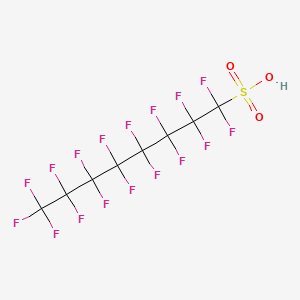

Hazard Assessment Summary Table Help CSV format XLSX format
| Assessment Type | Carcinogenicity | Mutagenicity | Reproductive Toxicity | Developmental Toxicity | Endocrine Disruption |
|---|---|---|---|---|---|
| Hazard Assessment Level |
Medium |
High |
Medium |
High |
Insufficient data
|
| Assessment Type | Acute Toxicity | Systemic Toxicity - Single Dose | Systemic Toxicity - Repeated Dose | Neurotoxicity - Single Dose | Skin Sensitization | Respiratory Sensitization | Skin Irritation | Eye Irritation |
|---|---|---|---|---|---|---|---|---|
| Hazard Assessment Level |
Very High |
Insufficient data
|
Insufficient data
|
Insufficient data
|
Insufficient data
|
Insufficient data
|
Very High |
Medium |
| Assessment Type | Acute Aquatic Toxicity | Chronic Aquatic Toxicity |
|---|---|---|
| Hazard Assessment Level |
Very High |
Very High |
| Assessment Type | Persistence | Bioaccumulation |
|---|---|---|
| Hazard Assessment Level |
Very High |
Very High |
| Assessment Type | Reactivity | Flammability |
|---|---|---|
| Hazard Assessment Level |
Insufficient data
|
Insufficient data
|
Hazard Diagnostic Modules
The Hazard Diagnostic Module consists of the following four computational chemistry methods. The predicted toxicity alerts are for reference only and should be evaluated together with other available data.
- Substructure Alerts
- Similarity Alerts
- Read-Across
- Classification Models
| Smarts | Endpoint | Source | Author | Journal |
|---|
Safer Alternatives
Safer alternatives are referenced from current safer chemical databases and software logic, divided into the following three categories:
- The system compiles industrial uses of chemicals from the US EPA ChemView database and integrates them with the US EPA Safer Chemical Ingredients to create a safer alternatives list for each chemical. Chemicals may have multiple industrial uses, so the system uses an accordion-style display. Click the 'Suggested Safer Alternatives' tab to expand the table. If the use is broad (e.g., 'Commercial use'), the list may include more specific uses (e.g., 'Solvent'). If no information is available, refer to 'By Industrial Use (Full List)' for manual filtering.
- Categorized by industrial use (full list). This list contains safer chemicals for industrial uses, not necessarily replacements for the chemical on this page. You may filter by industrial use via the search bar at the top right of this tab, e.g., filter by 'Antioxidants'. Source: Safer Chemical Ingredients List
-
Categorized by structural similarity, requiring:
- Find chemicals with similar functional groups based on structural similarity (Tanimoto coefficient ≥ 0.8), likely having similar functions.
- Chemicals identified as lower risk by risk assessment, such as level 3, level 4, or insufficient data.
- Based on real-world case studies. Source: OECD SAAT
Based on substructure, the system lists chemicals with risk levels 3 (usable but safer alternatives may be sought), 4 (safer chemicals), or insufficient data (U: not enough data to determine risk level). Information
Download:
CSV format
XLSX format
| Name | CAS | Industrial Use | Safety | Risk Level | Data Source | Notes |
|---|
Download:
CSV format
XLSX format
| Name | CAS | Industrial Use | Safety | Risk Level | Data Source | Notes |
|---|
Download:
SCIL (CSV)
SCIL (XLSX)
ZeroPM PFAS (CSV)
ZeroPM PFAS (XLSX)
SUBSPORT+ case alternatives (CSV)
SUBSPORT+ case alternatives (XLSX)
| Name | CAS | Industrial Use | Safety | Notes |
|---|
Source: ZeroPM Alternative Assessment Database v2.0 (published 2024/04; the Flagged column is as of 2022/01)
| Alternative | Type | CAS | Application | Technical feasibility | Market uptake | Source |
|---|
SUBSPORT+ substitution case stories
Real-world substitution cases involving this chemical, from the SUBSPORT+ case story database (English records).
| Case | Role of this chemical | Alternative | Sector | Function | Implementation | Reason for substitution |
|---|---|---|---|---|---|---|
| Substitution of PFC in paper with natural greaseproof paper. | Substituted | Non-chemical alternative The alternative to the addition of barrier chemicals commonly used when manufacturing greaseproof paper is a non-chemical alternative called natural greaseproof paper. The cellulose fibres are heavily refined in a mechanical way. This refining creates a very dense surface layer which acts as a natural oil and grease barrier on the paper. No barrier chemical is added and the barrier comes from pure cellulose in the surface layer of the paper. | Manufacture of pulp, paper and paper products | Film former Other | Full capacity — Sweden | vPvB |
| Mist suppression with non-PFOS (perfluoro octane sulfonate) surfactants for hard chrome plating | Substituted |
|
Manufacture of fabricated metal products, except machinery and equipment General manufacturing, e.g. machinery, equipment, vehicles, other transport equipment | Plating agent | Pilot study — 29.06.2011 | CMR PBT ecotoxicity |
| A new water repellent surface treatment which contain no fluorocarbons or isocyanates, to be used on textiles and other fibre-based materials. | Substituted |
|
Manufacture of textiles, leather, fur Manufacture of bulk, large scale chemicals (including petroleum products) | Finishing agents | Full capacity — March 2012, Sweden | CMR vPvB other toxic effects |
| Potentially environmentally sounder alternatives to PFOS compounds and PFOA | Substituted | Non-chemical alternative The most common types of compounds used: Telomer-based compounds Silicone based compounds Aliphatic alcohols Acrylates Consult the report for further details on each alternative. | Electricity, steam, gas water supply and sewage treatment Manufacture of computer, electronic and optical products, electrical equipment Manufacture of pulp, paper and paper products Manufacture of rubber products Manufacture of plastics products, including compounding and conversion Manufacture of textiles, leather, fur Printing and reproduction of recorded media Other | Other | In use | CMR other toxic effects |
| A new fluorine-free (PFC-free) water-repellent for textiles | Substituted |
|
Manufacture of textiles, leather, fur | Impregnation agent | In use — 2013, Germany | CMR other toxic effects |
| Root cause investigation of PFOS contaminations in leather garments | Substituted | Not stated | Manufacture of textiles, leather, fur | Other | Pilot study | ecotoxicity other reasons |
| Substitution of a reserving agent containing APEOs used in washing process on denim | Substituted |
|
Manufacture of textiles, leather, fur | Other | In use | ecotoxicity other reasons |
OECD SAAT alternative case studies
Full list of OECD SAAT case studies (not filtered by chemical).
| Case Study Name | Link | Publish Date | Publishing Organization | Related Products | Description |
|---|